
Category: Play Therapy

A kid and a doctor with clipboard, blocks and happy for evaluation, assessment or writing on floor.

Play Therapy Is a Child’s Language: What Parents Can Expect and Why It Works

Parents often ask what to expect in play therapy, especially when a session may look very different from the kind of therapy adults are used to. In my work with children, I start with a simple idea: Toys are children’s words, and play is their language.

Children communicate through their behavior, emotions, relationships, and play, not only through words. Adults are often better able to identify what they are feeling and explain what may have caused it. Even so, many adults struggle to explain why anxiety spills over or how to regulate an emotion while they are experiencing it. Children are still developing those skills.

Children are still developing those skills. Play gives them a developmentally appropriate way to communicate thoughts, feelings, experiences, relationships, and needs before they have the words to explain them.

Why Talking Alone Can Feel Like Pressure for a Child

A child may know that something feels upsetting, confusing, or scary without being able to tell you exactly why. When an adult asks direct questions, the child may feel pressure to produce an answer they do not yet have.

They may answer, “I don’t know,” change the subject, become quiet, or seem disconnected from the conversation. For a parent, those responses can be frustrating or worrying. But they do not necessarily mean the child is unwilling to participate. The words may simply be out of reach.

Talk can still be part of therapy. I just do not expect words to do all the work. Through play, a child can show us:

  • What feels safe or scary in their world
  • Where they feel powerful or powerless
  • How they understand relationships
  • What they may be trying to make sense of

Play is often how children naturally process their world. It allows therapy to meet them where they are instead of asking them to communicate like adults.

How the Playroom Helps Build Trust and Safety

The playroom gives children space to communicate without feeling as though they are being questioned or evaluated.

My playroom includes a variety of materials because different forms of play give children different ways to express themselves and practice skills. There is a dollhouse, dolls, paint, glitter, a basketball hoop, a sand tray, games, and other creative materials.

Each item is chosen intentionally. Together, the materials give children different ways to engage their senses, use their imagination, and express themselves. Still, there is no expectation that a child use a certain toy or choose a certain activity. In child-centered play therapy, they have room to decide what feels meaningful to them.

Having that choice can help children experience a sense of control and confidence within a safe relationship. They can move toward difficult feelings at their own pace, take a break when they need one, and return when they feel ready.

The materials are simply the medium. The relationship, safety, freedom to express themselves, and therapeutic process are what make the play meaningful.

What Children May Communicate Through Play

Sometimes, the concerns a child struggles to explain begin to show up in the stories, games, or situations they create.

  • A child who is experiencing anxiety may play out a story repeatedly in which something goes wrong, or a fear comes true. Over time, the child may try different ways of making the situation feel safer.
  • A child experiencing family changes may use figures or imaginative characters to work through belonging, loyalty, separation, changing family roles, or different expectations in different homes.
  • A child having difficulty with peers may recreate situations involving friendship, rejection, competition, arguments, fairness, or boundaries.

These themes can help me understand how a child experiences the world, but I do not interpret one toy or one play behavior as having one fixed meaning. A particular theme does not automatically point to a particular concern. Context matters, and the child’s individual experience guides how I understand the play.

I pay attention to patterns, repetition, intensity, frequency, and how the play progresses over time. I may notice whether a theme appears across multiple sessions, whether the child becomes especially emotionally engaged, how long they stay with an activity, or whether the play seems connected to concerns outside the playroom.

Play can carry meaning, even when that meaning is not immediately clear to an adult. My job is to remain curious enough to listen.

How Play Helps Children Practice New Skills

Play gives children a chance to practice emotional and social skills in a way that is active, meaningful, and appropriate for their development. Emotional regulation begins with self-awareness. Before a child can manage an emotion, they have to begin recognizing what they are experiencing.

Within play therapy, children may learn to notice, label, and communicate their feelings and needs. They can learn that every emotion is acceptable to experience while also discovering that they have choices about how they respond.

The play itself creates natural opportunities to work through everyday challenges. A child may:

  • Encounter a disagreement between characters
  • Lose a game or become frustrated
  • Need to decide what happens next in a story
  • Find another approach when something does not work

Those moments give us opportunities to practice flexibility, communication, perspective-taking, boundaries, frustration tolerance, and finding acceptable alternatives.

Children also learn through the social experiences they create. They practice making choices, cooperating with others, taking accountability, responding to limits, and repairing relationships. Rather than only talking about what they should do, they get the chance to experience and practice it.

What Parents Can Expect in Play Therapy

At Alderwood, the process begins with a parent consultation. That conversation gives us a chance to learn more about your child, your family’s concerns, and what you hope support might look like.

Once a child begins using the playroom, there is no single activity they are expected to choose and no correct way to play. One child may use imaginative figures. Another may prefer art, games, movement, or the sand tray.

The play therapist follows the child’s communication while also paying attention to the concerns that brought the family to therapy.

Meaningful patterns often become clearer over time rather than during a single session. I look at how the child’s play develops, how they respond to frustration or uncertainty, how they use the therapeutic relationship, and whether themes begin to shift.

From outside the room, the session may still look like simple play. Underneath, a child may be expressing emotions, practicing boundaries, making sense of relationships, or trying a different response to a difficult situation.

How Play Therapy Can Grow With a Child

Children’s ways of communicating naturally change as they get older. The tools used in therapy can change with them.

A younger child may communicate through figures, pretend stories, or sensory play. As a child moves into adolescence, therapy may include more art, games, role-play, creative problem-solving, or direct conversation.

An adolescent may move between talking and doing something with their hands. A game or creative activity can reduce the pressure of maintaining a face-to-face conversation while still creating room for meaningful communication.

The format may change, but the foundations remain the same:

  • A safe and trusting relationship
  • Freedom to express emotions
  • Developmentally appropriate choices
  • Support that respects the child or teen’s individual pace

Therapy can continue to meet young people where they are rather than asking them to fit themselves into an adult model.

A Safe Place to Begin When Your Child Needs Support

Your child does not need to have the right words before they can begin feeling understood. Play therapy creates space for children to communicate in a way that feels natural because children don’t have to stop being children to participate in therapy. It also gives parents a better understanding of what their child may be experiencing and what they need.

If you are considering play therapy, child and teen therapy, or are simply unsure where to begin, you can request an appointment. We’ll listen to your concerns, answer your questions, and help you determine what type of support may be the best fit for your child and family.

FAQs About Play Therapy

How long does a child usually participate in play therapy?

There is no set timeline for play therapy. The length of care depends on your child’s needs, developmental stage, concerns, comfort with the process, and how the work progresses. Your child’s therapist can discuss what they are noticing over time, but specific outcomes or timelines cannot be guaranteed.

What should I tell my child before the first appointment?

A simple, honest explanation is usually enough. You might tell your child they are going to meet someone who works with children and has a room where they can play, create, and talk. Try not to tell them what they need to discuss or how they should use the space, since less pressure can help them settle into the experience.

Will parents be involved in the therapy process?

Yes. Parent partnership is an important part of Alderwood’s approach, beginning with a consultation to understand your concerns and your child’s experiences. The type and frequency of parent involvement may vary based on your child’s age, needs, and therapeutic goals, and your therapist can explain what communication with parents may look like throughout the process.

How will I know if play therapy is helping my child?

Progress in play therapy is not always immediate or obvious. Over time, you may notice changes in how your child expresses emotions, responds to challenges, communicates with others, or manages everyday situations. Your therapist will also share observations and discuss how your child’s progress is developing throughout the process.

How can I tell whether my child needs play therapy or another service?

A parent consultation can help clarify which type of support may be the best fit. Your therapist will learn about your concerns, your child’s development, and what you are noticing at home, at school, or in relationships, then help you determine whether play therapy, child and teen therapy, an evaluation, or another service may be appropriate.
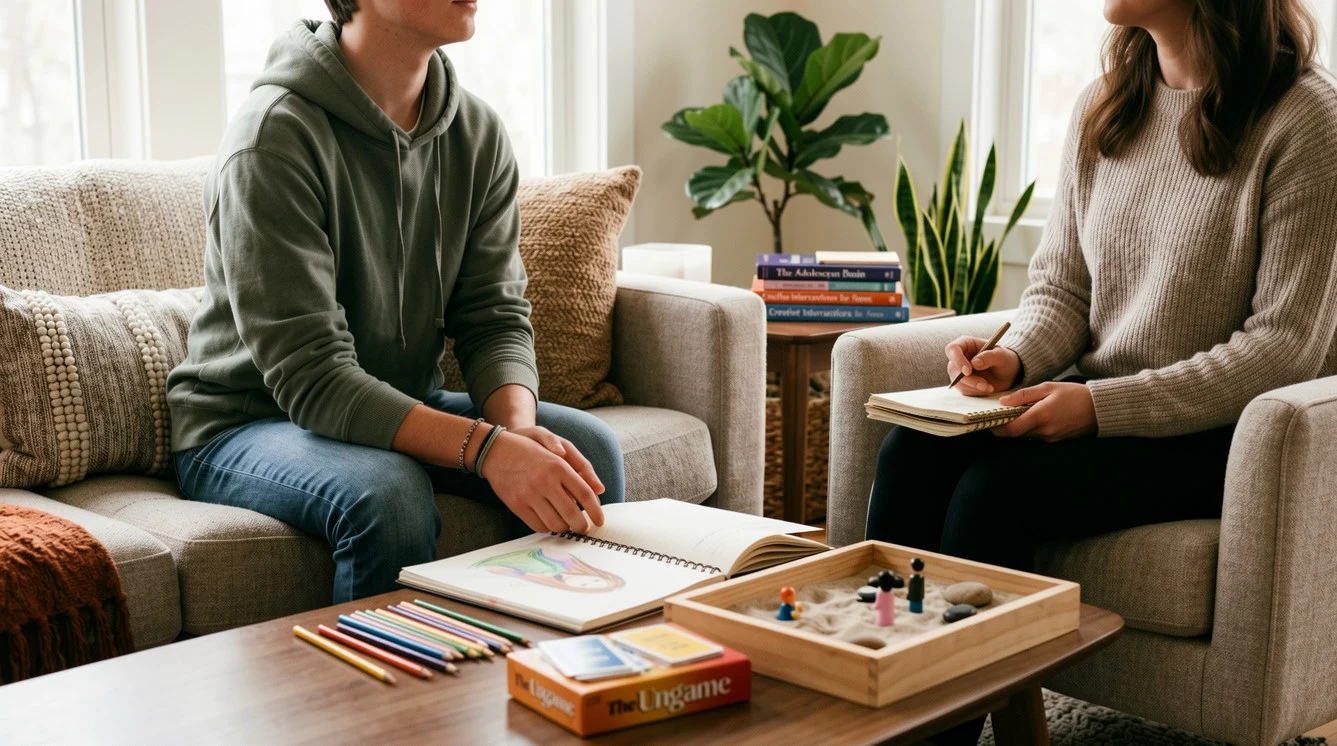

Teen boy talking with therapist during play therapy session, using sand tray and art materials for adolescent counseling

Play Therapy for Adolescents: Is It Right for Your Teen?

Parents ask me some version of this question all the time: “Is my child too old for play therapy?” It makes sense to wonder. When most people hear “play therapy,” they picture a young child sitting on the floor with toys. And yes, play therapy is often used with younger children because play is one of the main ways they communicate.

But play therapy is not only for little kids. Play therapy can also be a meaningful approach for older children, pre-teens, adolescents, and many teens. It just looks different as children get older.

With adolescents, play therapy is usually less about “playing” in the way a younger child might and more about using creative, expressive, relational, and activity-based ways to help teens communicate what may be hard to say directly.

Why Play Therapy Can Still Make Sense for Teens

Adolescence is a lot. Teens are trying to figure out who they are, how they fit with their peers, how to handle school pressure, how to be more independent, and how to manage emotions that can feel bigger than they know what to do with. Even when teens have the words, they may not always feel ready to use them.

I often think about how much pressure kids and teens can feel when adults ask, “What’s wrong?” or “Why did you do that?” Most of the time, adults are trying to help. But for a teen who already feels ashamed, defensive, confused, or overwhelmed, those questions can feel too big.

Play therapy creates a little more room. For older children and teens, that may mean we talk while doing something side by side. It may mean we use art, games, metaphors, sand tray, storytelling, or other creative tools to get at what is going on.

YouTube video player

What Play Therapy Looks Like for Adolescents Ages 12 and Up

Play therapy for a teenager should not feel babyish. That is one of the most important things I want parents to know. With younger children, play therapy may involve dolls, animals, blocks, pretend play, or sensory materials. With adolescents, the same therapeutic ideas may show up through:

  • Art, drawing, or creative projects
  • Games that support connection, problem-solving, or emotional expression
  • Storytelling, metaphor, or symbolic work
  • Music, movement, or other forms of self-expression
  • Conversations that happen while doing something side by side

For many adolescents, sitting across from an adult and talking directly about feelings for 50 minutes can feel intense. Some teens do beautifully with that. Others need a different starting point.

A game, a drawing, a creative project, or even a casual conversation while doing something else can lower the pressure. Teens often reveal more when they do not feel like they are being interviewed.

That does not mean therapy is “just playing.” I am always listening for what the teen is showing me: what feels hard, what feels unsafe, what patterns keep repeating, what coping strategies are helping, and which ones may be causing problems.

How Play Therapy Applies to Pre-Teens and Middle Schoolers

Pre-teens and middle schoolers are in such an in-between place. They may not feel like little kids anymore, but they are not usually ready for adult-style therapy either.

A 12- or 13-year-old may not want to be treated like a young child, but they may still open up more easily through drawing, games, movement, humor, or talking about a character or situation outside of themselves.

For this age group, play therapy may help with:

  • Anxiety and worry
  • Big emotions and emotional regulation challenges
  • Friendship or school-related stress
  • Family changes, grief, or difficult life experiences
  • Behavioral concerns at home or school

Middle school can be especially tender because children are often expected to act more maturely before they consistently have the skills to do that. They may look older, sound older, or push for independence, but emotionally, they may still need a lot of support.

How Play Therapy Applies to High Schoolers and Teenagers

High schoolers may be more independent, but they still need support. They are often carrying stress from school, friendships, family expectations, social media, identity questions, and the pressure to make choices that feel big.

With teens, therapy often works best when they feel like they have some choice and ownership. Play therapy for teens may involve more collaboration and flexibility. Depending on the teen, sessions may include conversation, creative expression, problem-solving activities, or other approaches that help them better understand and communicate what they are experiencing.

One of the unique aspects of adolescent therapy is balancing a teen’s need for privacy with a parent’s need for support and understanding.

Your teen needs to know therapy is a place where they can be honest. You also need to know how to support them at home. Therapy often includes parent check-ins or parent meetings so we can think together about what your child is communicating through their behavior and what may help outside of session.

When Families Might Consider Play Therapy for Adolescents

Sometimes parents tell me, “I know something is going on, but every time I ask, they say they’re fine.” That can be so hard. You can see your child struggling, but you cannot seem to reach them.

You may notice your child is more reactive, withdrawn, anxious, angry, tearful, shut down, or overwhelmed. You may be getting calls or emails from school. Your teen may be arguing more at home, avoiding things they used to manage, struggling with friendships, or seeming less like themselves.

Play therapy for adolescents may be a good fit when your child or teen:

  • Has trouble talking about emotions directly
  • Gets overwhelmed by big emotions
  • Has experienced stress, grief, trauma, or major life changes
  • Struggles with anxiety, worry, or perfectionism
  • Needs support with coping skills, communication, or emotional regulation
  • Seems more responsive to creative, activity-based, or relationship-focused approaches

Parents may also consider therapy when it feels like the same struggles keep showing up at home and nobody is quite sure how to move forward. Conversations become harder, conflict happens more often, or everyone starts feeling frustrated and stuck.

In therapy, we try to slow that down and understand it. What is the behavior communicating? What is your child trying to manage? What skills are missing? What support do they need from the adults around them? Those questions are often more helpful than asking, “How do we make this behavior stop?”

What If My Teen Does Not Want to Go to Therapy?

Many teens are unsure about therapy at first. Some are nervous. Some are skeptical. Some are worried they will be blamed, judged, or forced to talk about things before they are ready. That hesitation does not mean therapy cannot work.

For many adolescents, the first part of therapy is about safety and trust. Before a teen can talk about anxiety, anger, sadness, trauma, family stress, or behavior concerns, they need to know the therapist is someone who will listen without shaming them.

Play therapy can help because it does not require a teen to walk in and immediately explain everything. They do not need to have the perfect words. They do not need to know exactly what is wrong.

As a parent, you can also help by framing therapy as support rather than punishment. Instead of “You need therapy because your behavior is out of control,” you might say, “You’ve been carrying a lot, and I want you to have someone who can help you sort through it.”

That small shift can make therapy feel less like something being done to them and more like something being offered for them.

How Parents Are Involved in the Process

I care deeply about involving parents in a way that supports the child. That does not mean parents need to know every detail of what a teen says in therapy. Trust is important, especially with adolescents. But it does mean parents are part of the larger support system.

Parent meetings may focus on:

  • Understanding what may be underneath certain behaviors
  • Supporting emotional regulation and coping skills at home
  • Strengthening communication and reducing conflict
  • Coordinating support with school or other providers when helpful

I never want parents to feel blamed. Most parents who reach out are already trying so hard. They are reading, asking questions, having hard conversations, and trying to stay calm when things at home feel anything but calm.

How to Know If Play Therapy for Teens Is the Right Fit

Play therapy for teens may be worth considering if your child is struggling emotionally, behaviorally, socially, or with communication, especially if direct conversations are not helping.

A parent consultation can help clarify what kind of support makes the most sense. For some families, therapy is the right place to start. For others, an evaluation may help answer questions about learning, attention, emotional regulation, or development. In some situations, a combination of supports is the most helpful approach.

More than anything, families are often looking for clarity: a better understanding of what their child is experiencing and what support may be most helpful moving forward.

If your teen is overwhelmed, shutting down, acting out, or having trouble expressing what they need, play therapy may offer a path toward that understanding. For many adolescents, being understood starts before they have the words.

Taking the Next Step for Your Teen

Every child and teen is different, and there is no single approach that works for everyone. What matters most is finding support that feels appropriate for your child’s needs, personality, and stage of development.

If you’re wondering whether play therapy, child & teen therapy, or another service may be the right fit, you can request an appointment. We’ll help you talk through your concerns and determine what type of support may be the best fit for your child, teen, and family.

FAQs About Play Therapy for Adolescents


Is play therapy only for younger children?

No. Play therapy can be appropriate for adolescents, but it usually looks different than it does for younger children. With teens, it may involve art, games, creative expression, metaphor, conversation, or activities that help them feel more comfortable opening up.

What age is too old for play therapy?

There is not one exact cutoff. The better question is whether the approach fits your child’s needs, personality, and communication style. Some teens do well with direct talk therapy, while others connect more easily through activity, creativity, or side-by-side conversation.

What can play therapy help teens with?

Play therapy for teens may help with anxiety, emotional regulation, family changes, grief, trauma, school stress, friendship concerns, low self-esteem, and behavioral concerns connected to big feelings or difficulty communicating needs.

What if my teen does not want to go to therapy?

That is common. Many adolescents feel unsure about therapy at first. A therapist’s first job is often to build trust and help your teen feel safe, not to force them to talk before they are ready.

How do I know if play therapy or adolescent therapy is the right fit?

A parent consultation can help you talk through what you are seeing and what kind of support may make the most sense. From there, the therapist can help determine whether play therapy, adolescent therapy, parent support, or another service may be the best next step.

3 kids playing with an ipad

Kids Are Learning How to Play Again: Screens, Boredom, and Rebuilding Emotional Skills

If you’ve noticed a shift in your child’s screen time and kids’ behavior, you’re not alone. I hear this from parents all the time. Kids get bored faster, it feels harder to get them to play, and frustration shows up quickly. For some families, that looks like meltdowns when a game ends, irritability during transitions, or a child who insists on using a screen whenever there’s a gap in the day.

For other families, it may not feel like a “shift” at all. Some kids have grown up with screens as part of everyday life and learned to swipe and tap before they could even talk, so parents may not have had the chance to see how different things can feel without them.

Screens are not “all bad.” Some educational content can have a positive impact, and video chatting can help kids stay connected with family and friends. But I also think we’re living in a world where technology runs everything. And when screen use becomes the default, children have fewer opportunities to practice the emotional skills that develop through real-life play: waiting, negotiating, creating, coping with disappointment, and trying again.

Parents often ask, “How much screen time is too much?” Age, temperament, and family needs matter. The American Academy of Pediatrics emphasizes focusing on the quality of media use, co-viewing when possible, and keeping screen time and media use very limited for children younger than 2.

The goal of this post is simple: help you rebuild play, creativity, frustration tolerance, and emotion regulation in a way that feels realistic at home, alongside therapy when needed.

Why Boredom Matters More Than It Used To

I always say boredom is the leader of creativity. When kids aren’t bored, their brains don’t have to stretch. They don’t have to invent, problem-solve, or tolerate that “I don’t know what to do right now” feeling. And that’s a big deal, because those moments are where so many skills get built.

Boredom used to be a bridge. Kids would complain for a minute, wander around, pull out toys, invent a game, or bug a sibling until something happened. That process can be annoying for adults, but it’s part of how kids develop persistence and flexible thinking.

When a child’s brain expects constant stimulation, boredom can feel intolerable. A small “nothing to do” moment can turn into big feelings fast. That doesn’t mean your child is spoiled or broken. It often means they need more practice tolerating discomfort and more chances to build play skills again.

What Parents May Notice

  • Your child asks for a screen the moment they wake up or get home from school
  • Transitions away from video games or watching programs lead to emotional blowups
  • Free play feels “babyish” or “boring,” especially for older children
  • Your child prefers playing games on a device over social interaction in person
  • Behavior is worse after more TV, background TV, or long stretches on electronic devices

What Screen Time Can Crowd Out

Childhood is also a period of rapid brain development. During these years, the brain is especially ready to build skills through real-life experiences like play, problem-solving, and social interaction. When those experiences happen less often because screens fill the time, children may have fewer chances to practice the skills their brains are wired to develop during these important developmental windows.

Kids learn emotional skills through repetition. The trouble with excessive screen time is less about one show or even one hour and more about what gets replaced as time spent on screens grows.

Here are the skill areas that often get less practice with high screen use:

Frustration Tolerance

Play includes mini-failures. The block tower falls. The rules change. Someone wins, someone loses. Kids build tolerance by feeling the frustration and staying with it.

Emotion Regulation

Real play creates real feelings. Excitement, jealousy, worry, disappointment. Kids learn to handle those feelings when a trusted adult helps them label emotions and recover.

Creativity and Flexible Thinking

Creative play is open-ended. Kids decide what happens next. Screens tend to do that work for them, especially passive watching.

Social Skills and Language Development

Kids learn social skills through face-to-face interaction: reading tone, responding, repairing misunderstandings, and taking turns. Research reviews have explored links between screen time and outcomes such as language development, social interaction, and socio-emotional skills, particularly among younger children.

Physical Activity and Well Being

Movement supports mood, sleep, and attention. When hours a day drift toward sedentary screen time, physical activity often drops. Time outdoors also plays an important role. Sunlight supports healthy Vitamin D levels, and outdoor play gives kids opportunities to explore, get messy, and connect with nature in ways that support both physical and emotional development. Public health guidance also supports behavioral interventions to reduce children’s sedentary screen time during recreation, with evidence of improvements in physical activity and healthier weight-related outcomes.

Mayo Clinic also frames it in a way I really appreciate: unstructured playtime is more valuable for a young child’s developing brain than electronic media, and children learn best through interacting and playing with parents, siblings, and other children. They add that passive screen time shouldn’t replace reading, playing, or problem-solving, which are exactly the experiences that help build social-emotional skills over time.

“Too Much Screen Time” Looks Different in Every Family

Some families can manage the screen time kids use without big behavior changes. Others see a quick spiral. That difference is normal. A helpful way to think about “too much screen time” is to look for patterns, not perfection:

Signs Your Child’s Screen Time May Be Too High

  • Your child struggles to stop without anger or tears most days
  • Screen time is interfering with sleep, school routines, or family time
  • Your child loses interest in real-life activities they used to enjoy
  • You’re seeing more social isolation or fewer friendships
  • Your child needs more and more TV screen time to feel calm

What Kids Are Really Asking for When They Ask for a Screen

Sometimes “Can I have the iPad?” means:

  • “I don’t know what to do with myself.”
  • “I feel anxious, and I want to avoid it.”
  • “I’m tired, and I can’t cope with one more demand.”
  • “I’m lonely, and I want a connection.”
  • “I’m angry, and I don’t know how to settle.”

Screens can provide quick emotional support in the moment. The long-term work is helping your child build other ways to reset.

How to Rebuild Play Skills Without Turning Your House Into a Battle Zone

Limiting screen time can get messy before it gets better. That’s not failure. Often, it’s a sign that the screen was doing its job, and your child needs support in learning other ways to cope. Here are practical steps that tend to help families the most.

1. Start With One Predictable “No-Screen” Block

Pick a time that’s already a transition point, like:

  • After school until dinner
  • The first hour after waking up
  • The hour before bedtime

Keep the expectation simple and consistent. Kids do better with “always” rules than “sometimes” rules. If your child is younger, you might start with a shorter block. Older children may need more structure and more replacement activities.

2. Replace, Then Reduce

Kids can’t drop a coping tool without gaining another one. Create a short “boredom menu” your child can choose from:

  • Legos, Magnatiles, or blocks
  • Art supplies (paper + markers counts)
  • A bin of “challenge” toys (puzzles, model kits, building sets)
  • Outside time engaging in movement (walk, scooter, basketball)
  • Music plus a hands-on task (Play-Doh, drawing, crafts)
  • Reading time, especially if you join for 10 minutes

3. Expect Frustration, and Coach It in Real Time

If you take away a screen and your child melts down, the lesson is not “screens are evil.” The lesson is “big feelings are here, and we can handle them.” Try language like:

  • “You’re mad. Stopping is hard.”
  • “Your brain wants more. That feeling passes.”
  • “I’ll help you pick something else.”

4. Make “Background TV” a Specific Target

Background TV often increases the time spent passively watching without anyone noticing. It can also disrupt play because the child’s attention keeps getting pulled back. Try one change:

  • Keep the TV off unless someone is actively watching a planned program
  • Turn it off during meals, homework, and playtime

5. Use Parental Controls as Support, Not as the Whole Plan

Controls reduce daily conflict, but they don’t teach coping skills on their own. Kids still need help practicing transitions and learning how to settle without a device. Parental controls can help with:

  • Time limits
  • Bedtime shutdowns
  • Blocking certain programs or social media
  • Managing purchases or downloads

6. Treat “High Quality Programming” Differently Than Endless Scroll

Quality matters. The American Academy of Pediatrics encourages families to focus less on rigid limits and more on how media fits into a child’s day, content quality, and how families engage with it. A few practical ways to bring that to life:

  • Co-watch occasionally and talk about what you’re seeing
  • Choose educational programs intentionally, instead of autoplay
  • Avoid violent behavior content, especially for younger kids
  • Keep screens out of bedrooms when possible

What to Do When Your Child Can’t Play (Yet)

Some children truly don’t know how to start. Screens may have been filling that space for a long time, or anxiety and perfectionism may make play feel risky. If that sounds familiar, start smaller.

Children learn a lot through modeling, so it can also help when parents make space to disconnect from screens and join in simple play or creative activities. We as adults are often navigating the same pull toward screens, and showing kids how to pause, explore, and play offline can be a powerful lesson in itself.

A Gentle “Play Ramp” for Younger Children

  • Sit on the floor for 10 minutes
  • Start the play (you build the first tower, you start the pretend scene)
  • Narrate simply: “You’re making the dinosaur jump.”
  • End while it’s still going well, not after a crash

A “Re-Entry” Plan for Older Children and Young People

Older kids may not want “play,” but they still need creativity and real-world mastery.

  • Cooking, baking, or building projects
  • Sports or movement goals (physical activity counts, even if it’s short)
  • Art, music, photography
  • Board games or card games (social interaction plus frustration tolerance)
  • Clubs, volunteering, or structured time with friends

How Therapy Supports This Work

In therapy, kids practice emotional regulation with a trusted adult. For younger kids, play therapy can be a developmentally appropriate way to express feelings, process experiences, and build coping strategies through play and creativity.

Parents are part of the process, too. Many children make more progress when families use the same language and skills at home that they’re practicing in sessions. I also want parents to hear this clearly: you’re not supposed to do this perfectly. It’s not one-size-fits-all. What works for one kid may not work for the next, and that’s okay.

Therapy also helps clarify what else might be driving screen reliance, like anxiety, ADHD, learning differences, or social stress. For some kids, screen use becomes a way to avoid hard moments at school or in friendships. Understanding the “why” changes the plan.

A Next Step if Screen Time Is Becoming a Daily Struggle

If your child’s screen time feels tied to behavioral problems, anxiety, or social challenges, support can help. Families don’t have to figure it out alone. A thoughtful plan often includes practical changes at home and, when appropriate, therapy that helps kids build emotional skills in a safe, supportive setting.

If you’d like to talk through what you’re seeing and what kind of support might fit your child, you can request an appointment or connect with our team at Alderwood Psychological Services. We’ll help you sort through next steps and choose a path forward that feels realistic for your family.

FAQ: Screen Time and Kids’ Mental Health


How much screen time is okay?

There’s no single number that fits every family. Age, content, and what screen time replaces matter. The American Academy of Pediatrics recommends keeping screen time and media use very limited for children younger than 2, focusing on quality and family engagement over strict universal limits.

Is video chatting different from other screen use?

Yes. Video chatting can support connection with family and friends because it involves real interaction rather than passive watching.

What if my child calms down only with screens?

That’s a common reason screens become the default. Start by adding other calming options (movement, sensory tools, music, drawing, reading together) and practice them when your child is already mostly okay. Kids learn regulation skills best before they’re in a full meltdown.

Do I need to cut screens to zero?

Most families do better with clear boundaries than total bans. A consistent plan plus replacement activities usually works better than extreme changes that are hard to maintain.

A kid and a doctor with clipboard, blocks and happy for evaluation, assessment or writing on floor.

Play Therapy Is a Child’s Language: What Parents Can Expect and Why It Works

Parents often ask what to expect in play therapy, especially when a session may look very different from the kind of therapy …

Is It School Anxiety or Just a New School Year Adjustment?

The beginning of a new school year can be a big adjustment for children, even when they were excited to go back. I often …

Young girl sitting alone in classroom looking down, showing signs of sadness or anxiety at school

Why Your Child’s Struggles May Look Different at Home and School

Sometimes parents come in and say, “I don’t even know where to start.” By then, they are often trying to …